
THOUGHT LEADERSHIP
The Questions AI Can't Answer Alone
23 January 2026
#AI Singapore, #AAAI 2026, #Symposium
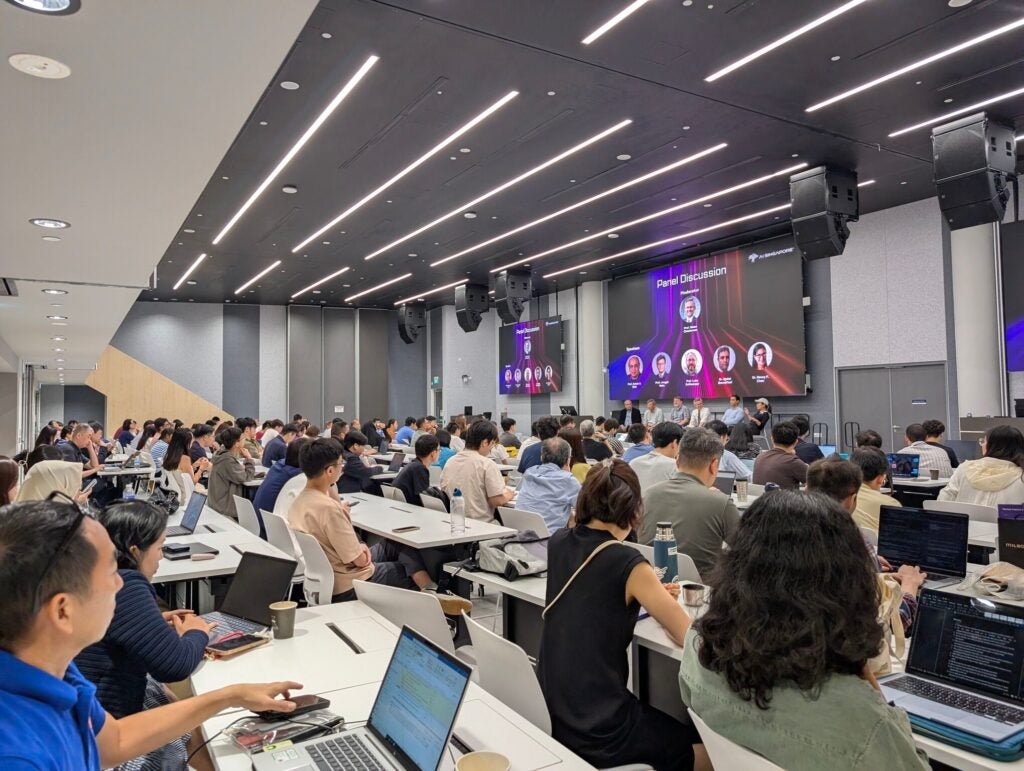
The packed auditorium at Singapore AI Research Week said something before a single speaker took the stage: these questions matter now, and the people who need to grapple with them know it.
The AI Singapore Symposium on The Right to Learn, Work, Own & Choose — held 23 January 2026 as part of Singapore AI Research Week, running in parallel with AAAI 2026 — brought together five keynote speakers whose work sits at the hardest edges of AI’s relationship with human capability.
Prof Ashok Goel (Georgia Tech) shared research suggesting AI did not necessarily impede adult learning outcomes — but was careful about what that finding does and doesn’t mean. Adults who study with AI are intrinsically motivated and were shaped by conventional learning environments. Younger generations with immediate access to generative AI may respond very differently. Learning, he observed, is a social and emotional process — which is exactly what makes AI-assisted education a genuinely difficult design challenge, not a straightforward deployment.
Prof Jungpil Hahn (NUS Computing) proposed deliberately building friction into AI-enabled workflows — junior staff should build cognitive maps through manual work before being given access to AI shortcuts. Know what you’re using, and earn the right to use it. Prof Luke Zettlemoyer (University of Washington & Meta FAIR) opened up copyright-aware language modelling through Retrieval Augmented Generation and modular architectures. Dr Nancy F. Chen (A*STAR) brought careful attention to cultural nuance in multimodal AI development — a model for how to build systems that serve diverse communities rather than imposing a single linguistic lens.
Dr Djallel Bouneffouf (IBM Research) offered the day’s most philosophically striking frame: the Shepherd Test. Would a superintelligent AI treat humans the way we treat other species — managing, directing, or overriding our choices in the name of the greater good? The question maps four real dimensions: nurturing, manipulation, instrumentalisation, and ethical justification. Which of those we’re designing toward is not yet settled.
KEY TAKEAWAYS
- Learning is a social and emotional process — which is exactly what makes AI-assisted education so hard to get right. AI may not retard learning in controlled studies of motivated adults, but those results carry assumptions. Younger generations shaped from the start by generative AI may respond very differently. The research implications haven’t caught up with the deployment reality.
- The Shepherd Test poses a question worth sitting with: would a more capable AI manage us the way we manage other species? Dr Bouneffouf’s frame isn’t just provocation — it maps four concrete dimensions of how a superintelligent agent might engage with weaker ones. Nurturing, manipulation, instrumentalisation, and ethical justification are all plausible trajectories. The question is which we’re designing toward.
- Peer review integrity is already under pressure — and the academic community hasn’t fully caught up. Hallucinated references, desk rejections, and hidden prompt injections in submitted manuscripts are no longer hypothetical. The right to know whether a paper is substantially AI-generated — and to act on that knowledge — is a governance question that needs an answer before the next major conference cycle.
MORE ON THOUGHT LEADERSHIP

Building Resilience in the Age of AI
Professor Jungpil Hahn, Director of the NUS FinTech Lab, joined a panel on “Building Resilience in the Age of AI” at A*STAR’s Singapore Scientific Conference. The discussion centred on a critical shift:

Insights from Melbourne: AI Governance, Higher Education, and Organizational Design
Prof Hahn Jungpil recently returned from Melbourne after participating in the International AI Cooperation and Governance Forum (IAICGF) and delivering a research talk at the University of Melbourne’s School of