
Project

NUSwap – Simulated Trading Exchange

Overview

We have developed a cryptocurrency simulated trading platform to provide a controlled, risk-free environment for students to experiment with and test their investment strategies using real-time market data. By bridging theoretical knowledge with practical application, the platform fosters experiential learning while also serving as a valuable resource for research.

Key Features

Experiential Learning

Enables students to apply investment strategies in a realistic but risk-free setting.

Algorithmic Trading

Test automated strategies with real-time market data.

Data Collection

Generate datasets for future research on trading behaviors and performance.

Key Milestones

Global Experiment
Participants from NUS, Morgan State University (US), and FGV (Brazil) participated in a trading contest using the platform.
Recognition
Findings presented at UBRI Connect 2024 in ETH Zurich.
Collaboration
Professors from NUS, MSU (U.S.), and FGV (Brazil) are incorporating the platform into their courses.
Previous slide
Next slide

Testimonial

Application Demo

Play Video

We invite educators, researchers, and institutions to join us in expanding this initiative. If you’re interested in using the platform, please email us at fintech@comp.nus.edu.sg. Together, let’s shape the future of education and research in trading and behavioural finance.
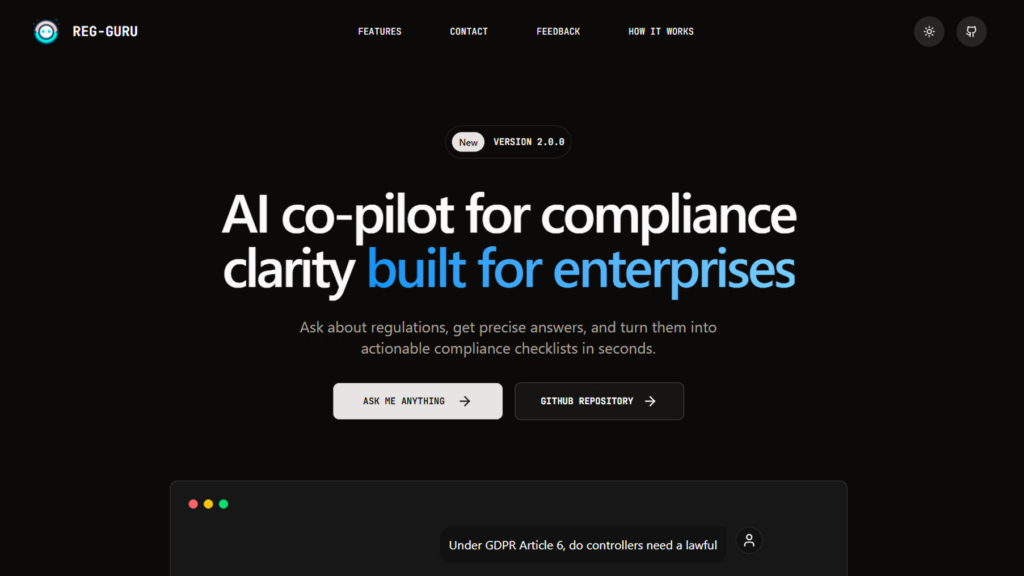
Reg-Guru: Simplifying Regulatory Compliance with AI

Overview

Compliance is a critical requirement in the financial sector, yet meeting regulatory obligations is often resource-intensive and complex. Reg-Guru is a lightweight retrieval-augmented generation (RAG)–powered compliance assistant built to make financial regulations easier to navigate. It provides contextual answers in real time based on collections of regulatory documents. Teams and individuals in banking and finance can use it to clarify requirements, reduce uncertainty, and save effort. It works in multi-languages and multi-jurisdictions. For start-ups, Reg-Guru offers tailored compliance checklists that simplify early planning. Subscribers also receive timely notifications on regulatory updates, keeping them informed as rules evolve.

Key Features

Document Collection

Reg-Guru maintains a public collection of regulatory documents and updates it regularly. All the documents are parsed and indexed automatically for better information retrieval.

Context-Aware Response

Based on the relevant information in the document collection, Reg-Guru provides more accurate responses compared to a pure generative language model. It supports multi-jurisdictional queries with ease.

Key Milestones

Initiative
Project was initiated as an MComp Capstone Project at NUS FinTech Lab.
Recognition
A working prototype was demonstrated on UBRI Connect 2025 Pre-summit Day in Singapore.
Previous slide
Next slide

Demo

We invite teams, institutions and companies to join in using, evaluating, and improving Reg-Guru, especially for real-world compliance cases. If you are interested in this project, please email us at fintech@comp.nus.edu.sg. We look forward to an open discussion with you.

Due Diligence Pipeline – Generating Open Source Intelligence Dossiers for Donor Vetting

Overview

Institutions need to secure philanthropic support and manage reputational risk through comprehensive donor due diligence. A due diligence process normally involves manually gathering, analyzing, and aggregating complex data from sources scattered across public, private and paid platforms, which requires high staff effort. In order to automate the due diligence process, people sometimes use Gen-AI tools, such as ChatGPT and DeepSeek, to auto-generate PDF dossiers in batch. Such generative models take in names and some keywords and populates profiles for the given entities. However, two main challenges in the implementation are:

  • LLM Hallucination: Models provide fake or conflicting information about a person / organization
  • Ambiguation between Named Entities: Models sometimes cannot differentiate entities with the same name, even with keywords provided.
Hence, this project aims at developing a trustable pipeline for due diligence while dealing with these challenges.

Key Features

Chain of Trust

Ensure that profile data is tightly linked to the webpage it is extracted from. Make each fact traceable and verifiable.

Clustering of Profiles

Use agglomerative clustering with human intervention to check if there are ambiguous profiles in the mix.

Looking Forward

  • Named Entity Recognition
    Use NER to improve web scraping quality – discard paragraphs where named entity is not mentioned.
  • Confidence / Reliability Score
    .gov, .edu , forbes – a list of high trusworthy sites. We can use source reliability to label each of our data points
  • Fuzzy Match Similar Inputs across Sources
    Fuzzy matching of values across sources while retaining their verifiability

XFund – Decentralized Education Funding Platform

Overview

XFund is a decentralized education funding platform that connects students with corporate sponsors through blockchain technology.

Our goal is to expand access to education beyond traditional systems like government loans or bank financing, which are often rigid, limited in scope, or inaccessible to private school students, foreigners, and bootcamp learners.

In the current phase, companies sponsor students by paying their tuition upfront in exchange for a commitment to work with them after graduation, similar to a bonded scholarship. XFund facilitates this matchmaking process via a transparent, on-chain agreement. Students submit their loan requests with details like course of study and career goals. Companies browse these listings and propose custom funding offers, including terms like employment duration, conditions, and salary range. 

Once both parties agree, XFund uses the XRP Ledger (XRPL) to create a binding contract in two ways:

  • NFT Minting – Each agreement is represented by a unique NFT containing contract metadata: parties involved, repayment terms, and more. This NFT serves as a digital bond.
  • XRPL Escrow – Tuition funds are held in XRPL’s native escrow, only released to the educational institution when invoices are due. This ensures funds are used as intended, removing middlemen and reducing risk.

Key Features

Bonded Scholarship

Companies sponsor tuition upfront, with students committing to work for them post-graduation

Transparent Contracts

Transparent, on-chain contracts on the XRP Ledger via NFTs & escrow ensure trust and security

Flexible Funding Options

Students get more flexible funding options beyond government loans or banks, including private school & bootcamp learners

Milestones

Initiative
Initiated and developed by the XFund Team, Ong Si Hui (Ariel), Sumit Sanjay Shinde, and Brian Chua, during EasyA × Ripple APEX Hackathon on June 7-8, 2025.

Application Demo

Looking Ahead

In the future, XFund plans to:

  • Introduce a true loan model, where students receive funding and repay it post-graduation (either partially or fully) alongside optional employment with the sponsor.
  • Enable companies to publicly post sponsorship and scholarship offers on the platform. Instead of only browsing student listings, companies can advertise open funding opportunities, allowing students to discover, browse, and apply to individual scholarships that match their goals or background—bringing a job board-like experience into education financing.
  • Explore AI-powered risk assessment, trained on academic performance, institution quality, course competitiveness and more, to further enhance decision-making. This data-driven risk model could be offered as a premium tool to sponsors, helping them evaluate default risk and tailor offers accordingly.

Ultimately, XFund aims to become the protocol layer for decentralized, borderless student finance, where education is funded based on potential, not privilege.

Fractionate – Real World Asset Tokenization

Overview

Fractionate is a real estate tokenization platform designed to address the industry’s pain points by utilizing blockchain technology. By creating a more efficient process for registering properties for investment, Fractionate simplifies the traditionally complex and time-consuming steps involved in property registration, making it more accessible for all stakeholders.

Key Features

Fractional Ownership

Fractionate allows investors to purchase a portion of a property, rather than the entire asset, making real estate investment opportunities available to a broader audience.

Fractional ownership democratizes the real estate market, enabling smaller investors to benefit from property appreciation and rental income.

Decentralized Trading System

Fractionate provides increased liquidity and flexibility, allowing users to trade their property tokens more freely and efficiently. 

By enabling seamless transactions within a decentralized framework, Fractionate enhances the accessibility and fluidity of real estate investments. 

Key Milestones

Recognition
The working prototype was demonstrated at UBRI Connect 2024 in ETH Zurich.

Application Demo

Verifin – Securing Blockchain Transaction with Recipient Identity Auto-Validation

Overview

Today, a growing number of companies are leveraging public blockchains to collect revenues or pay employees and suppliers, primarily due to the benefits of cost savings and increased efficiency, particularly in cross-border transactions. However, malicious actors often exploit these systems through phishing, impersonation, or address poisoning attacks, redirecting B2B or B2C payments to incorrect destinations. While pseudo-anonymous and irreversible payments are generally valued within the blockchain community, these characteristics can deter traditional businesses from adopting blockchain for daily operations due to the associated risks.

To overcome these barriers to the adoption of cryptocurrency in B2B and B2C payments, this project introduces an innovative framework that allows payers to verify the recipient’s real-world identity (RWI) during transactions by adding a layer of identity validation through smart contracts. The platform prototype, developed on the XRPL-EVM sidechain, integrates technologies such as Merkle Trees, organization-wide and government-issued public key infrastructure (PKI), and third-party ID verifiers to securely bind or verify an identity.

Key Features

Fool-proof Mechanism

Attestation for business wallet requires 2 pairs of dual signature with different signing nonce.

Off-chain Signature Nonce

The unique nonce for off-chain signing expires after 10 mins to prevent replay attack.

Anti-forgery Detection

Aliyun Cloud KYC maintains security features for worldwide ID and detect frauds with ML.

Attestation Revocation

Identity can be disassociated when the private key is lost, stolen, or decommissioned.

Milestones

Recognition
The working prototype was demonstrated at UBRI Connect 2024 in ETH Zurich.

Application Demo

Verifin – the decentralized and automated framework demonstrates how businesses can safely incorporate blockchain technology into their everyday financial activities, providing a secure solution that addresses common concerns and facilitates wider adoption.

If you are interested in this project, please email us at fintech@comp.nus.edu.sg.

Scroll to Top