Congratulations to the NUS FinTech Society (FTS) Blockchain team on their success at the ETH Oxford Competition 2025! Over the course of the event, they demonstrated focus, skill, and creativity, earning three awards across multiple tracks. Their achievements reflect the dedication and talent of the team and offer a glimpse into the future of blockchain and decentralized finance.
Let’s hear from the winners about their experience at ETH Oxford 2025.
ETH Oxford 2025
ETH Oxford is the largest blockchain hackathon at Oxford University, organized annually by the Oxford Blockchain Society. Held at the university’s prestigious Mathematical Institute, with a prize pool exceeding $100,000 USD, this three-day event brings both experienced and new developers to build and collaborate together.
In the midst of a chilly February, five representatives across three teams from NUS Fintech Society hacked tirelessly for around 40 hours in Oxford. Their hard work paid off when each team managed to win their targeted bounty prize, with one managing to win the main consumer prize, totalling to more than $10,000 USD, roughly 10% of the total prize pool.
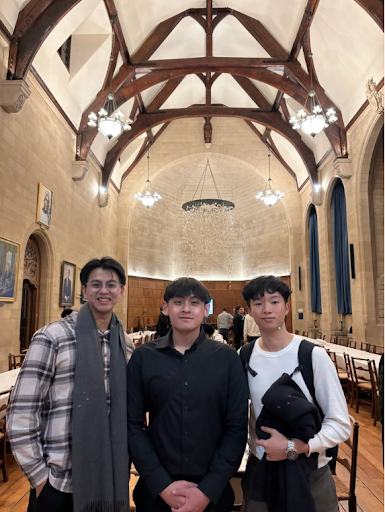
Moreover, the winners of the main tracks were invited to an exclusive gala dinner at the prestigious Rhodes House, home to one of the world’s most distinguished scholarship programs – the Rhodes Scholarship, a symbol of academic excellence at Oxford University. The historic venue provided an elegant backdrop for attendees to celebrate their collective success, network with prominent Web3 founders and investors, and strategize their next steps moving forward.
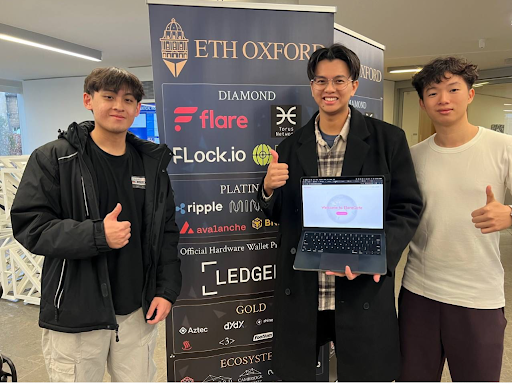
Left to Right: NUS SoC team - Jefferson Lee Chun Yin, Jerial Chan Zhi Yang, Kevin Lim Teng Hong
The Process
The hackathon officially kickstarted at 6pm on 7 February 2025. Our efforts, however, started one week before. Once some of the problem statements were released, we started researching, learning and bouncing ideas off each other. Two days before the hackathon commenced, Jeff reached out to Philip, the person in charge of the Flare track, seeking his opinions on our idea, requesting API keys to their data connector, and inquiring about other related technical details, and Philip was kind enough to assist us.
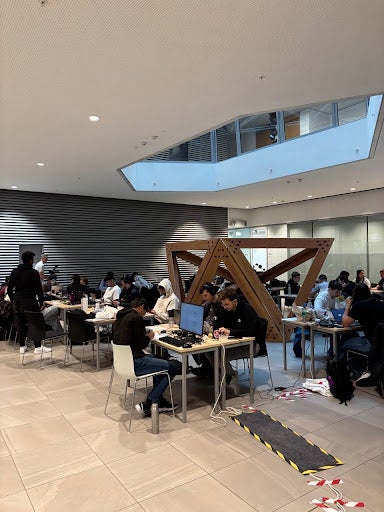
For the next 3 days, we spent our days hacking at the basement floor of the Mathematical Institute, while our nights were spent at the hacker house, provided by the ETH Oxford team.
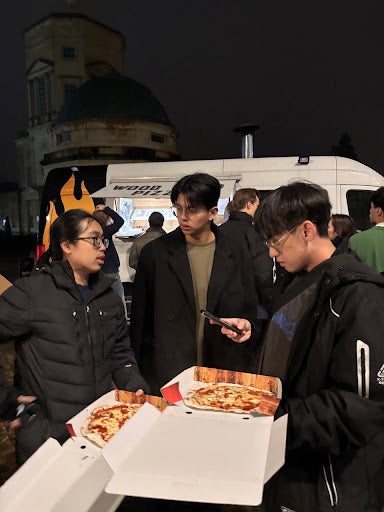
Our daytime hours were packed with intense hacking sessions, with a few insightful workshops. From time to time, we also looked for representatives from each of our bounty tracks to seek technical help as well as feedback. The organising team kept us well fed with freshly cooked paella for lunch and on-the-spot wood fired pizzas for dinner. It was fantastic!
However, one major challenge that we faced was the instability of WiFi connection. With so many participants connected to the same network, internet bandwidth struggled. Determined to find a more reliable connection, we constantly relocated, from the main hacking area to an empty workshop room. We eventually went up to the main lobby, which was where we discovered the best WiFi spot.
The night before our submission, we powered through the final stretch with instant coffee and instant noodles, making sure that our project was completed and of the highest quality before submission. We took turns taking short naps intermittently till 6am, then we ultimately succumbed to the sleep demons for the next 2-3 hours. The next morning, we managed to fix the last few bugs, prepared our presentation slides, and filmed our demo video. Then, we headed down to the venue one last time for our final presentation. And finally, it was over!
The Outcome
These are the 3 winning projects submitted by the teams.
FlareGate
by Jerial Chan Zhi Yang, Jefferson Lee Chun Yin, Kevin Lim Teng Hong
1st for main track (consumer), 1st for Flare Track
FlareGate is a decentralized peer-to-peer (P2P) platform designed to facilitate seamless on-ramping and off-ramping between fiat currencies and cryptocurrencies. Leveraging Flare Network’s Data Connector (FDC), FlareGate ensures trustless and efficient transactions by securely integrating off-chain data into on-chain smart contracts.
NUS SoC Team - Left to Right: Jerial Chan Zhi Yang, Jefferson Lee Chun Yin, Kevin Lim Teng Hong
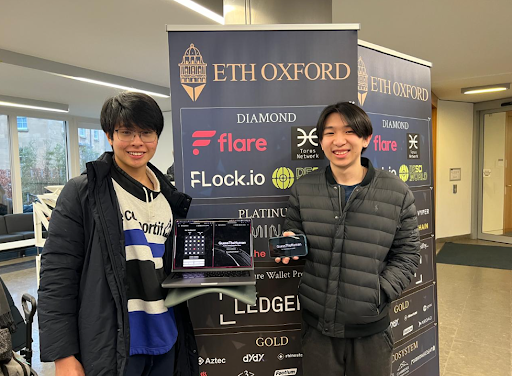
Guess The Human
by Chua Wei Rong (NUS), Jason Chai Jian Hao (University of Bristol)
1st for AirDao Track
Guess The Human is a disruptive new blockchain-based AI-driven Turn Based Social Deduction game where players attempt to identify the human-controlled player among AI agents moving randomly on a 2D grid. The game consists of two main roles: players and guessers.
Left to Right : Chua Wei Rong (NUS SoC Team), Jason Chai Jian Hao (University of Bristol)
Mina Verify
by Marcus Pang Yu Yang (NUS SoC Team – No photo taken)
2nd for Mina Track
This project implements the BLS12-381 signature scheme, enabling developers to verify such signatures through MINA’s smart contract. This enables important use-cases such as cross chain bridges, allowing other chains to settle on MINA, and signature aggregation.