
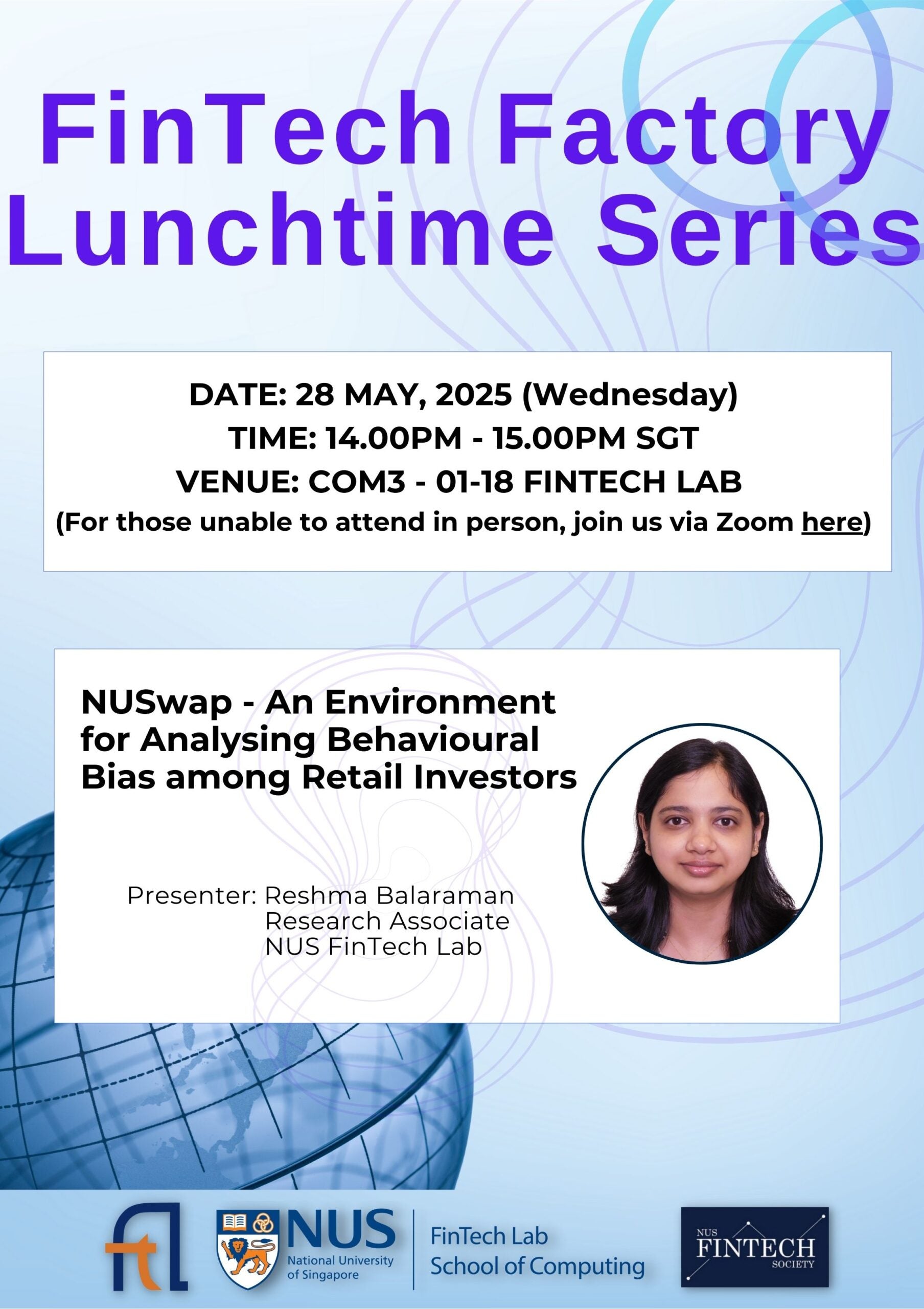
BrownBag Series Recap
Date: 25 May. 2025
Speaker: Reshma Balaraman, Research Associate, NUS FinTechLab
This BrownBag session explored retail investor behavior in financial markets, analyzing how everyday traders respond to wins, losses, and changing market conditions. Using on-chain transaction data and controlled experiments on the NUSWAP platform, the discussion highlighted how behavioral biases like overconfidence, loss aversion, and the disposition effect shift across different environments—and how these insights can inform both market design and investor protection.
Understanding the Problem
Retail participation in financial markets is accelerating, driven by mobile apps and real-time platforms. While this democratization has opened opportunities, it has also introduced challenges:
- Design features such as push notifications and gamified interfaces shape how traders think, react, and decide under pressure.
- Unlike educational settings, retail traders rarely receive behavioral feedback, leaving them vulnerable to biases that influence decision-making.
- At scale, these individual tendencies can aggregate into market-wide instability.
Understanding these dynamics is therefore critical—not only for academic research, but also for consumer protection and regulatory priorities.
Key Behavioral Biases Studied
The session examined five core biases, operationalized through trading signals:
- Disposition Effect – Selling winners too early, holding losers too long.
- Gambler’s Fallacy – Expecting a win after a losing streak.
- Loss Aversion – Losses felt more intensely than gains, causing hesitation.
- Overconfidence – Past success inflates perceived trading skill.
- Risk Aversion – Preference for smaller bets after losses.
Bias detection relied on on-chain behavioral data such as trade timing, position size changes, and delays between trades.
Dataset & Methodology
- 200,000+ transactions, across 20,000+ wallets over 12 months.
- Filtering excluded bots and inactive traders, yielding a focused sample of 2,031 active wallets.
- Biases were detected directly from trading patterns, not surveys or self-reports.
This approach allowed for robust behavioral inference at scale, grounded in real-time decision-making.
Key Findings
- Context-Dependent Biases
- Disposition effect strongest in calm markets (65% of traders), but drops in high volatility (15%).
- Biases are dynamic, not fixed; traders adapt to changing conditions.
- Overconfidence & Market Regimes
- Surges in momentum markets (≈60%), but falls in mean-reversion environments.
- Can improve outcomes during strong trends, but backfires when conditions flip.
- Loss Aversion & Drawdowns
- Loss-averse traders experience much deeper drawdowns (~20% vs ~5%).
- Reluctance to cut losses turns small setbacks into long-term risks.
- Biases as Double-Edged Swords
- Behaviors labeled “irrational” in calm markets may protect traders in volatile ones (e.g., avoiding whipsaws).
Role of NUSWAP: From Observation to Intervention
The discussion emphasized why NUSWAP was built as a research platform:
- Streams live market data to simulate real pressure.
- Provides a risk-free environment for participants.
- Enables both manual and algorithmic trading, allowing structured strategies.
Through SIMTRADE contests (NUS, FGV Brazil, Morgan State University), NUSWAP has generated datasets from 125+ participants, confirming its potential as a behavioral finance lab.
Research Questions & Discussion
During the session, the audience raised key questions for future exploration:
- How can nudges be designed to prevent harmful bias-driven behavior?
- Can interventions be personalized to different trader profiles?
- What frameworks would allow integration of behavioral safeguards into consumer protection regulation?
- How can NUSWAP be scaled across universities to build a global dataset for collaborative research?
Key Takeaways
- Retail investors matter: Their behaviors influence not only individual outcomes but also market dynamics.
- NUSWAP bridges the gap: From detecting biases to testing interventions in a controlled yet realistic setting.
- Towards investor protection: The long-term goal is to design platforms and policies that support safer, smarter trading.